British Bulldog Health Testing — What It Really Means and What to Ask
Health testing happens before a puppy exists — in the breeding adults, before any pairing. This article explains the panel that matters for British Bulldogs, why ADAMTS3 sits in a category of its own, and the exact questions to ask a breeder before paying a deposit.
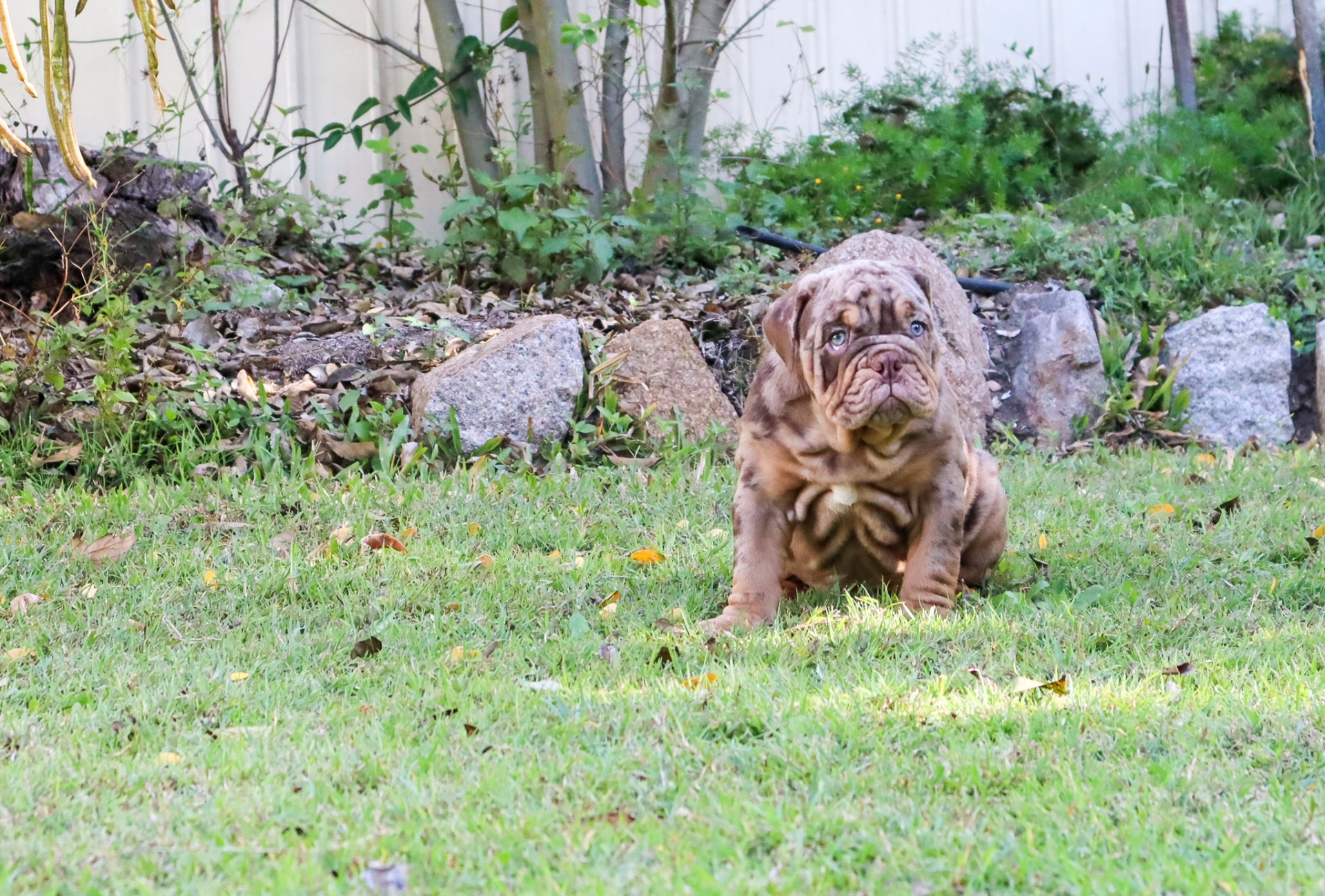
One day you might be sitting in a specialist's waiting room.
Your dog beside you. And you'll be asking yourself — how did we get here?
Sometimes that answer leads back to a decision made before your dog was born. Before it had a name. Before you found the listing.
That decision was either made carefully, with everything modern science allows — or it was not made at all.
Health testing is not a marketing term. It is that decision. Made in advance. With data. This is what it actually looks like.
Two words that mean almost nothing
You will hear it from almost every breeder you speak to: vet checked, healthy pup.
Those words describe a puppy's observable health on one particular day. They say nothing about what its parents carry. Nothing about the decisions that were or were not made before that puppy was conceived.
Most British Bulldogs that go on to develop inherited health problems were vet checked before sale.
The check happened after. The problem was already there.
Before your puppy existed
The tests that matter are not run on puppies. They are run on the adults who will become their parents — before a single pairing decision is made.
A DNA health panel looks at what a breeding dog carries and could pass on. In British Bulldogs, these are the conditions that matter.
HUU — Hyperuricosuria. A dog with HUU looks healthy. It plays, eats, sleeps like any other dog. And then one day — sometimes at two years old, sometimes at five — it is in agony from crystals and stones that have been quietly building in its kidneys or bladder since before it was born. A single DNA test on its parents, run before any pairing decision was made, would have changed the odds entirely.
CMR1 — Canine Multifocal Retinopathy 1. An inherited eye condition causing multiple lesions on the retina. Not every affected dog loses significant vision — but every carrier passes it on silently, invisibly, to the next litter and the next. The test was available before any pairing decision was made. Whether it was run was a choice.
DM — Degenerative Myelopathy. This one may be the cruellest on this list. It does not appear in a puppy. It creeps in later — hind limbs weakening, coordination failing, a dog that once ran now struggling to stand. By the time a buyer sees it, the purchase decision is years in the past. By the time a vet names it, nothing can be done. The test was available before that dog was born.
Cystinuria — Types I-A and III. British Bulldogs are susceptible to two distinct forms. Type I-A is autosomal recessive — a dog needs two copies to be affected, with carriers showing nothing outwardly. Type III, known as the Bulldog Type, involves mutations in two separate genes and is androgen-dependent: intact males carry significantly higher risk. Both types cause crystals and stones in the urinary tract. Real pain, in a dog that cannot tell you where it hurts, from a condition that a test could have anticipated before it was ever born. And they are not the same test.
For every one of these conditions, a dog can carry the gene silently — looking and behaving completely normally — while passing the risk to every puppy it produces. The risk only becomes visible in the offspring of two carriers paired together. A 25% chance of an affected puppy, in every single litter, from a pairing that testing could have changed.
The test alone changes nothing. What the breeder does with the result is what changes the puppy's life.
The test that changes what's possible
Everything above matters. This one is in a different category.
ADAMTS3 is the Airways Oedema Gene. It causes swelling — oedema — in the airway tissue. In a British Bulldog, whose anatomy is already compressed, that swelling compounds everything.
Think about what brachycephalic anatomy already means: a shortened skull, compressed nasal passages, a palate that does not quite fit the space it occupies. Now add a gene that causes the tissue lining those airways to swell. Every breath becomes harder than it should be. Not because of shape alone — because of swelling on top of shape.
Most British Bulldogs carry two copies of this gene variant. A dog with one copy is less affected. A dog with zero copies does not carry this susceptibility at all — its airways are not impacted by this gene-driven oedema — and it passes that result to every puppy it produces.
This is recent science. Among the most significant genetic discoveries for the breed in a generation. The Master Dog Breeders and Associates in Australia introduced mandatory ADAMTS3 testing for all British Bulldog breeding dogs in 2020 specifically because of how prevalent and how serious this variant is across the breed.
Most breeders in Australia have not implemented it. The ones who have, have results that are documented, tracked and managed across generations.
If a breeder mentions ADAMTS3, ask for the copy number results for both parents. Ask what copy numbers the pairing is designed to produce in offspring. If they cannot answer specifically, the mention exists to impress you, not to inform you.
“ADAMTS3, the Airways Oedema Gene, causes swelling in the airway tissue. In a breed with already-compressed anatomy, this compounds breathing difficulty significantly.”
The test is not the point. This is.
Here is where most programs fall apart.
Testing is information. Acting on it is the program.
A breeder who tests all dogs and still pairs two HUU carriers has not run a health program. A breeder who knows their dog carries two copies of ADAMTS3 and keeps using it because it produces beautiful puppies has not run a health program. A breeder who identifies a Cystinuria Type III carrier in an intact male and breeds him anyway has not run a health program.
Testing that does not change decisions is a paper trail. Not a practice.
When you ask a breeder about health testing, the question that matters is not what do you test? It is what changed because of what you found?
That is the question that separates science from window dressing.
What we can promise — and what we can't
We use every tool modern science makes available. DNA panels on all breeding adults. ADAMTS3 Airways Oedema Gene testing. Pairing decisions made on data, not aesthetics.
And we need to say this plainly: we are still breeding living creatures.
We cannot promise your dog will never need a vet. We cannot promise a life with no health challenges. Anyone who makes that promise is not being straight with you.
What we commit to is that every decision made before your puppy existed was informed by the best available science, applied honestly — a commitment to giving that dog the best possible start.
The difference between a tested program and an untested one is not perfect dogs versus imperfect dogs. It is a meaningful, deliberate reduction in known, preventable risk — pursued by people who took it seriously enough to act on what they found.
Before you hand over the money
Ask for the named DNA tests run on both parents. Not "full DNA testing" — which specific markers. HUU, CMR1, DM, Cystinuria Types I-A and III, and ADAMTS3.
Ask for the ADAMTS3 copy number result for both parents. A breeder running a genuine program can answer immediately. A breeder who cannot is telling you something.
Ask what the results changed about the pairing.
These are not difficult questions for a breeder with a real program. They are very difficult questions for a breeder using the language of testing without the practice behind it.
You are spending thousands of dollars on a living creature you will love for a decade or more. You are allowed to ask.
For the breeders reading this
The buyers asking those questions are increasing. The market is becoming more informed because the dogs have been paying the price when it doesn't.
But set the market aside.
Testing without acting on results produces the same outcomes as not testing — at greater expense, with better documentation. That is not a health program.
A real program tests all breeding adults before any pairing. Acts on what it finds. Manages ADAMTS3 copy numbers with intention across generations. And is honest — with itself and with buyers — about what science can and cannot do.
We cannot produce perfect dogs. Nobody can. We can produce dogs whose start in life was shaped by the best available science, applied properly. That is what the work is.
Key Takeaways
- "Vet checked" is a same-day observation of a puppy. Health testing is what happens before the puppy exists — in the breeding adults, before any pairing is made.
- A British Bulldog DNA panel must cover HUU, CMR1, DM, and both types of Cystinuria (I-A and III). These conditions are carrier-silent — a dog looks and behaves completely normally while carrying and passing on the risk.
- ADAMTS3 — the Airways Oedema Gene — causes swelling in the airway tissue. In a breed with already-compressed anatomy, this compounds breathing difficulty significantly. Most British Bulldogs carry two copies. Managing this gene across generations is the single most impactful thing a breeding program can do for breathing outcomes.
- Cystinuria has two distinct types in British Bulldogs — Type I-A and Type III. They involve different genes, different inheritance patterns, and require separate tests. Testing for one is not testing for both.
- Health testing meaningfully reduces known, preventable risk. That is the honest truth of what it offers — and it matters enormously.
- Before a deposit: which tests, what results, what changed because of them.
Frequently Asked Questions
Sources and References
Marchant, T.W., et al. (2019). An ADAMTS3 missense variant is associated with Norwich Terrier upper airway syndrome. PLOS Genetics, 15(5): e1008102 — https://doi.org/10.1371/journal.pgen.1008102
Bannasch, D., et al. (2008). Mutations in the SLC2A9 gene cause hyperuricosuria and hyperuricemia in the dog. PLOS Genetics, 4(11): e1000246 — https://doi.org/10.1371/journal.pgen.1000246
Guziewicz, K.E., et al. (2007). Bestrophin gene mutations cause canine multifocal retinopathy: a novel animal model for best disease. Investigative Ophthalmology & Visual Science, 48(5):1959-1967 — https://doi.org/10.1167/iovs.06-1374
Awano, T., et al. (2009). Genome-wide association analysis reveals a SOD1 mutation in canine degenerative myelopathy. PNAS, 106(8):2794-2799 — https://doi.org/10.1073/pnas.0812297106
Brons, A.K., et al. (2013). SLC3A1 and SLC7A9 mutations in autosomal recessive or dominant canine cystinuria: a new classification system. Journal of Veterinary Internal Medicine, 27(6):1400-1408 — https://doi.org/10.1111/jvim.12176
Master Dog Breeders and Associates (MDBA), Breeding Brachys for Health program requirements — https://mdba.net.au
Sources are cited for the mechanisms described above. Where a mechanism has been characterised in another breed, that limitation is stated in the relevant section rather than generalised to British Bulldogs.
About Hollywood Bulldogs AUS
Hollywood Bulldogs AUS is an MDBA-registered British Bulldog breeding program focused on evidence-led health selection, ADAMTS3 testing and transparent owner education. Educational content does not replace individual veterinary advice.
MDBA #18715
Continue Exploring the Program
Health Testing
British Bulldog Health Testing Australia: Why DNA Is the Only Honest Measure
A British Bulldog can look healthy. That tells you how it looks on that day, in that room. It cannot tell you what it carries. It cannot tell you what it will pass on. DNA testing answers the questions that phenotype cannot.
Genetics & DNA
ADAMTS3 British Bulldogs Australia: The Science, the Research, and Why It Matters
ADAMTS3 is an important airway oedema risk marker considered in British Bulldog breeding decisions. This guide explains what current research shows, what ADAMTS3 testing can tell you, and why it should always be interpreted alongside structure, function and whole-dog assessment.
Choosing a Breeder
How to Choose a British Bulldog Breeder in Australia
If you have owned a British Bulldog before, you already know what a wrong choice costs. It costs in vet bills, in surgeries you were never warned about, in watching a dog you love struggle to breathe. This guide exists for people who want to get it right — and for people who need to understand exactly why getting it wrong is so costly.