British Bulldog vs English Bulldog Australia — Same Breed, Different Name
Explains why British Bulldog and English Bulldog refer to the same breed, how the Australian Bulldog differs, and what to look for when buying a British Bulldog in Australia.
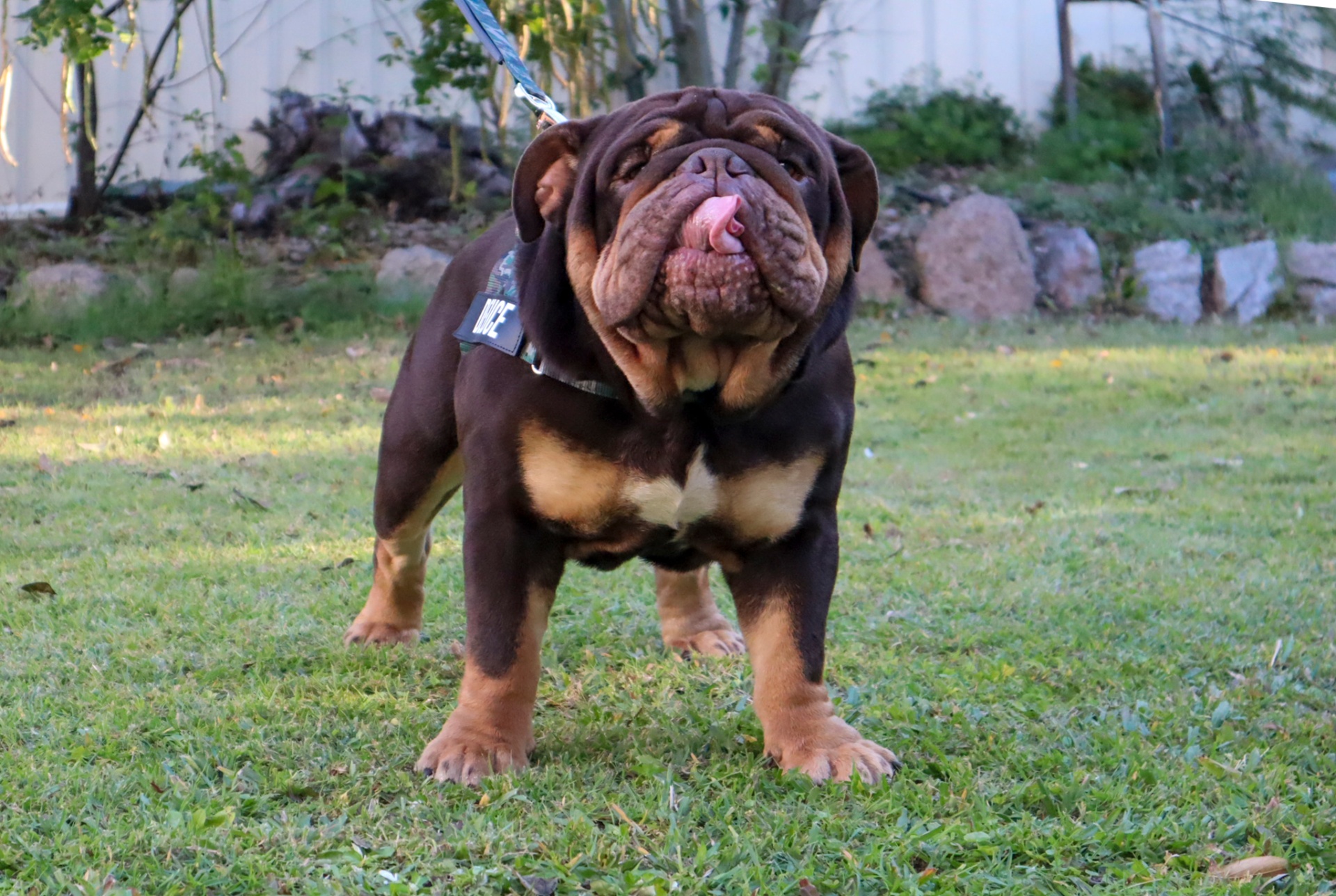
Are British Bulldogs and English Bulldogs the same breed?
The breed's origins are British. Developed and standardised in England over centuries, "British Bulldog" carries that history — and is the name used across Australia and the United Kingdom.
When the breed reached the United States, "English Bulldog" took hold informally as a way of distinguishing it from the French Bulldog and, later, the American Bulldog. Neither name is incorrect. They evolved separately to describe the same animal.
The conformation standard, the temperament, the gene pool — none of these differ between what an Australian calls a British Bulldog and what an American calls an English Bulldog. The dog you are looking for is the same dog, whatever name led you here.
“The name changes depending on where the person talking about it learned the word — the breed does not.”
Where does the name English Bulldog come from?
The Kennel Club in the United Kingdom — the oldest breed registry in the world — registers the breed as "Bulldog." No country prefix. The breed existed before the need for one.
The Australian National Kennel Council registers the same breed as "British Bulldog," acknowledging its country of origin.
The AKC registers it as "Bulldog" too. American breeders and buyers adopted "English Bulldog" informally, and that name spread globally through social media, export listings, and online content.
When you see "English Bulldog" in an Australian listing, the dog behind it is the same breed the ANKC registers as "British Bulldog." The name on the listing is American. The breed behind it is not.
Is an Australian Bulldog the same as a British Bulldog?
The British Bulldog was developed in a cooler climate. Its compressed airway, its build, its coat — these features can create real challenges in the Australian heat. The breeders who created the Australian Bulldog were responding to that reality.
The result is a taller, more athletic dog — longer in the leg, more active — that shares some temperament traits of the British Bulldog but is a genuinely different breed with a different breeding target.
British Bulldogs bred with attention to ADAMTS3 — an important airway oedema risk marker considered alongside structure, function, health testing and whole-dog assessment — can be better prepared for Australian conditions than British Bulldogs bred without that information. The breed is the same. The information behind the litter is not.
“Choosing between an Australian Bulldog and a British Bulldog is a real breed decision — choosing between 'British' and 'English' is not.”
How does a British Bulldog compare to a French Bulldog?
Both breeds have brachycephalic features and the health considerations that come with them. The specific anatomy differs. The specific genetics differ. The research covering each breed differs.
If you are deciding between the two, the practical considerations are size, activity level, and the health documentation available. If you are choosing between the names British and English, that is not a choice — they are the same breed.
22–25 kg. Low, wide, muscular. Calm, heavy companionship. Brachycephalic. ADAMTS3-testable. ANKC registered as British Bulldog.
8–13 kg. Compact, upright, more active. Alert, energetic, vocal. Brachycephalic. Separate health research landscape. Different breed standard.
What should I look for when buying a British Bulldog in Australia?
The name on the listing is not what you are taking home.
A British Bulldog puppy is born with the structure it has. The genetics that may influence airway oedema risk — including ADAMTS3 copy number — are present from conception. The name used in the listing that led you there was not.
ADAMTS3 is an important airway oedema risk marker in British Bulldogs, identified by Marchant et al (2019, PLOS Genetics). It is considered alongside structure, function, health testing and whole-dog assessment. Copy number is inherited. A 2-copy parent paired with a 2-copy parent produces exclusively 2-copy offspring — the combination associated with the highest oedema risk. Whether that pairing was made or avoided was decided before the puppy was born, using multiple evidence streams including DNA screening, structure, functional assessment, temperament, health information, pedigree and long-term breeding objectives. No single test determines breeding decisions.
At Hollywood Bulldogs AUS in Brisbane, every breeding adult and every puppy is ADAMTS3-tested.
Professional veterinary services are engaged on a fee-for-service basis where required. Cord tissue is collected from each puppy at delivery and laboratory testing determines each puppy's ADAMTS3 result.
Testing is conducted by Dog Breeding Science, an Australian veterinary genetics laboratory in Redfern, NSW. Samples never leave the country.
You are taking home a dog whose genetics, structure and health information were already in place before it existed. What those factors are was decided before your first search, using multiple evidence streams including DNA screening, structure, functional assessment, temperament, health information, pedigree and long-term breeding objectives. No single test determines breeding decisions.
“The listing name is not what you are taking home.”
Australia's first documented 1-copy female
Australia's second documented 1-copy male
Australia's first documented 0-copy British Bulldog males
Hollywood Bulldogs AUS holds Australia's largest collection of ADAMTS3-tested 0-copy and 1-copy British Bulldogs
Key Takeaways
- British Bulldog and English Bulldog are the same breed — the name varies by country, with "British Bulldog" standard in Australia and the UK, and "English Bulldog" the common informal term in the United States
- "English Bulldog" is not a formally registered breed name with any major breed registry — it is a colloquial American term that spread globally through online content and export listings
- The Australian Bulldog is a genuinely different breed, developed in Australia in the 1990s from British Bulldog crosses — it has a separate breed standard and different conformation
- French Bulldogs are a different breed entirely — smaller, more active, with a separate gene pool and a separate health research landscape
- ADAMTS3 is an important airway oedema risk marker in British Bulldogs, considered alongside structure, function, health testing and whole-dog assessment — it helps inform breeding decisions, which are made using DNA screening, structure, functional assessment, temperament, health information, pedigree and long-term breeding objectives
- The name on a listing does not reflect the information behind the litter. Whether a breeder has documented ADAMTS3-tested adults and explained how those results sit alongside other evidence is what helps reduce avoidable uncertainty
A Hollywood Bulldogs AUS puppy arrives with its ADAMTS3 result documented. Cord tissue is collected at delivery and laboratory testing determines each puppy's ADAMTS3 result. Find out what's available.
Apply for a puppyFrequently Asked Questions
About Hollywood Bulldogs AUS
Hollywood Bulldogs AUS is an MDBA-registered British Bulldog breeding program focused on evidence-led health selection, ADAMTS3 testing and transparent owner education. Educational content does not replace individual veterinary advice.
MDBA #18715
Continue Exploring the Program
Genetics & DNA
ADAMTS3 British Bulldogs Australia: The Science, the Research, and Why It Matters
ADAMTS3 is an important airway oedema risk marker considered in British Bulldog breeding decisions. This guide explains what current research shows, what ADAMTS3 testing can tell you, and why it should always be interpreted alongside structure, function and whole-dog assessment.
Breathing, Trachea & Functional Health
British Bulldog Breathing Australia — Trachea Size, ADAMTS3, and What Genetics Actually Cover
Breathing function in a British Bulldog is shaped by upper-airway structure, tracheal anatomy, ADAMTS3 copy number, body condition and management. No single variable determines the outcome; each is assessed separately and considered together.
Health Testing
British Bulldog Health Testing Australia: Why DNA Is the Only Honest Measure
A British Bulldog can look healthy. That tells you how it looks on that day, in that room. It cannot tell you what it carries. It cannot tell you what it will pass on. DNA testing answers the questions that phenotype cannot.