The True Cost of Owning a British Bulldog in Australia
The true cost of owning a British Bulldog in Australia, broken down for buyers and breeders. Covers purchase price and what it reflects, ongoing costs including insurance and grooming, how ADAMTS3 copy number directly affects lifetime veterinary cost, the real cost of running a program under MDBA Breeding Brachys for Health standards, and what the price of a puppy should actually tell you.
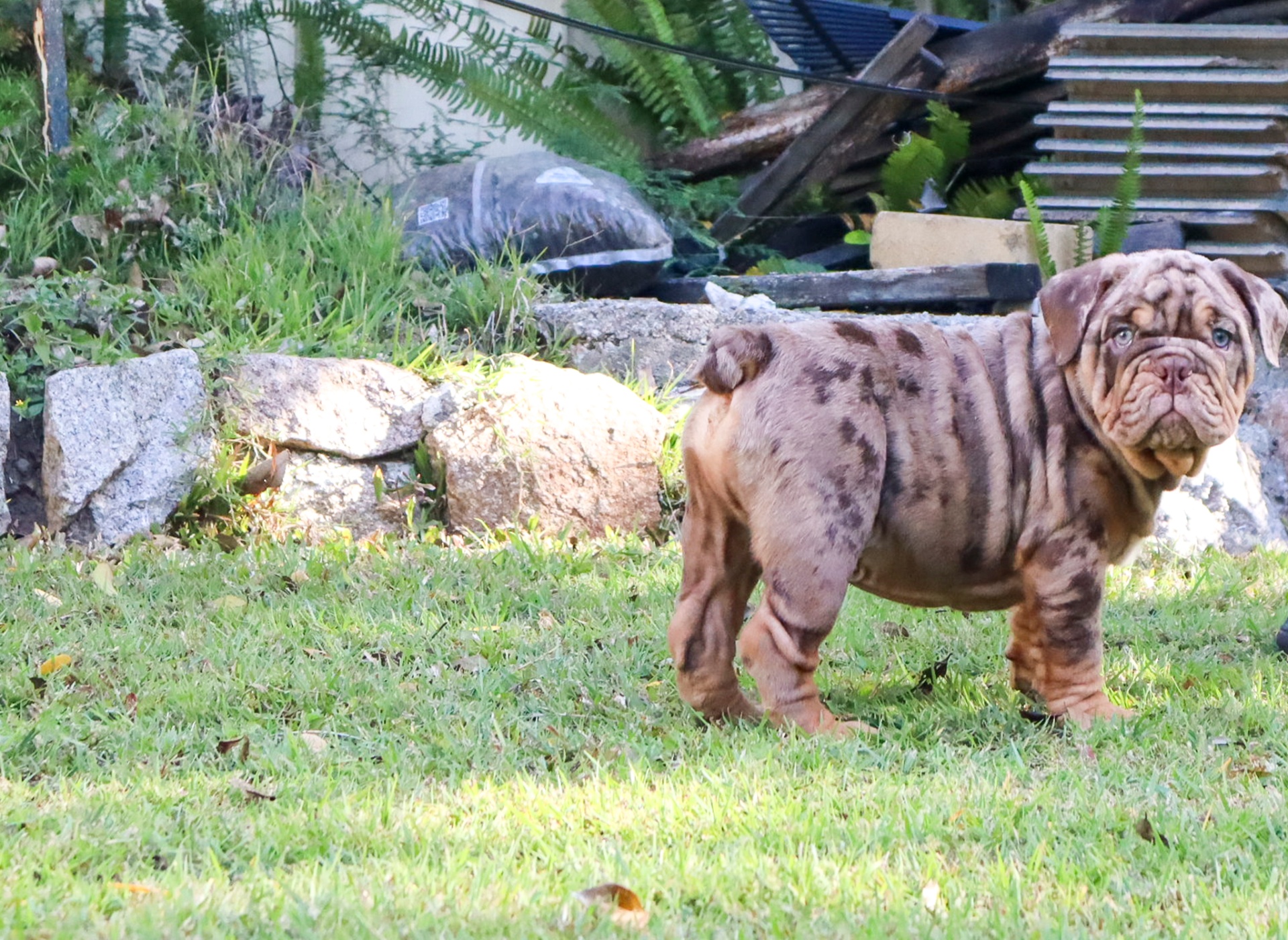
How much does a British Bulldog puppy cost in Australia?
A puppy from a breeder operating under the MDBA (Master Dog Breeders and Associates) Breeding Brachys for Health program has a different cost structure behind it than one from an unregistered or untested source. ADAMTS3 testing, a planned caesarean performed by a reproductive veterinarian, cord tissue collection for individual puppy testing, and MDBA registration — each of these carries a cost the breeder absorbs before the litter is available. For the puppy you are considering, those costs exist inside the price whether they are itemised or not. The question is whether they were incurred.
The puppy you are considering at a lower, undocumented price point does not carry lower lifetime costs — it carries unknown ones. A dog purchased from an unregistered or untested source will, if it carries two copies of ADAMTS3, eventually arrive at the same veterinary specialist. The acquisition decision will then carry a veterinary cost the documentation could have helped anticipate.
The documentation attached to the puppy you are considering tells you what was spent before you met that animal. An ADAMTS3 copy number result for both parents, individual puppy testing from cord tissue, MDBA registration — each is evidence of investment already sunk. For a buyer evaluating two puppies at different price points, that is the comparison worth making.
“The purchase price of a British Bulldog is the number that stops you — the veterinary invoice is the number you live with.”
What are the ongoing costs of owning a British Bulldog in Australia?
Pet insurance for a brachycephalic breed in Australia carries a surcharge that reflects actuarial reality. Insurers that cover British Bulldogs at all typically charge $120–$300 or more per month depending on the level of cover, the age of the dog, and whether breed-specific exclusions apply. For the puppy you are considering, reading the policy exclusions before you choose a provider is not administrative caution — it is the decision. A policy that excludes respiratory conditions for brachycephalic breeds is a policy that excludes the primary source of cost in this breed.
British Bulldogs require regular fold cleaning — face, tail pocket, paw interdigital areas — as a routine maintenance task. Skin infections in undercleaned folds are a source of recurring veterinary cost that is almost entirely preventable. Professional grooming every six to eight weeks costs $60–$100 per visit; home maintenance done consistently costs nothing beyond time. Dental disease accumulates early in brachycephalic breeds — a routine dental clean under anaesthetic runs $500–$1,200 depending on severity and frequency. For the puppy you are considering, establishing both fold and dental hygiene at eight weeks eliminates two of the most avoidable recurring costs in the breed.
A British Bulldog on a quality diet costs $100–$180 per month in food. Annual vaccinations, flea, tick, and heartworm prevention, and routine check-ups add $600–$1,200 per year in baseline veterinary costs under normal circumstances. For the puppy you are considering, these fixed costs do not vary significantly between a documented and an undocumented dog. The variation is in what comes next.
“Pet insurance for a brachycephalic breed is not optional — it is the cost of managing a known risk.”
What are the veterinary costs for a British Bulldog in Australia?
ADAMTS3-related airway oedema — identified by Marchant et al (2019, PLOS Genetics) as the primary genetic driver of breathing problems in British Bulldogs — is the primary source of early specialist veterinary cost in the breed. Routine veterinary costs in the first year run $800–$1,500. Specialist airway intervention, when required, runs $3,000–$8,000 or more depending on what is addressed and how early it is caught. For the puppy you are considering, the question is whether the genetic driver of the most common high-cost intervention in this breed has been documented and reduced before you purchased it.
A documented zero-copy puppy carries no ADAMTS3-related airway oedema risk from this gene. That does not mean zero veterinary costs — bulldogs have multiple health considerations, and no single genetic test eliminates all risk. But the largest driver of early specialist cost in the breed — a mechanism present in approximately 98% of British Bulldogs, who carry at least one copy — has been removed from the equation for that dog. For a buyer choosing between a cheaper undocumented puppy and a more expensive documented one, the cost differential at purchase is not the relevant comparison. The relevant comparison is across the lifetime of each dog.
At Hollywood Bulldogs AUS, every caesarean is managed by Dr Scott Norman — BVSc, PhD, DipACT, MANZCVS, Registered Specialist in Veterinary Reproduction, Diplomate of the American College of Theriogenologists, and Adjunct Associate Professor of Theriogenology at Charles Sturt University, with close to four decades of specialist reproductive practice. Dr Norman manages every caesarean and every semen collection. Cord tissue collected at delivery by Dr Norman is the source of the individual ADAMTS3 results recorded for each puppy in every litter. For the puppy you are considering, that standard of care at birth is the first medical event in that animal's life.
“ADAMTS3 copy number is not only a health variable — it is a cost variable.”
What does it cost to run a British Bulldog breeding program properly in Australia?
British Bulldogs cannot whelp naturally in the vast majority of cases. A caesarean with a registered specialist reproductive veterinarian costs significantly more than one performed under general practice conditions — and the difference in capacity for documentation, cord tissue access, and surgical outcome reflects that cost. At the level of care provided at Hollywood Bulldogs AUS, every whelping involves a specialist reproductive vet managing both the surgery and the cord tissue collection that produces individual ADAMTS3 results for each puppy. For a breeder evaluating their current whelping arrangements, the question is what the caesarean facility produces beyond a live litter.
ADAMTS3 testing through Dog Breeding Science — DBS, 40 Boronia Street, Redfern NSW, with all samples processed within Australia — carries a per-sample cost applied across both breeding parents and every individual puppy in each litter. MDBA registration is a recurring annual cost and the baseline credential for participation in the Breeding Brachys for Health program (Hollywood Bulldogs AUS: member #18715). Semen collection and cryopreservation for frozen storage, chilled transport logistics for fresh and chilled semen, and progesterone testing for timing are additional costs of maintaining a semen program of any scale. For a breeder whose program includes semen sales as well as live litters, all of these costs are absorbed or passed through — but none are eliminated by not accounting for them.
The output of a properly costed and documented program is not only live puppies — it is a verified record of every genetic decision made within it. For a breeder building a program around documented ADAMTS3 reduction, each litter is a data point: the copy number the pairing produced, the proportion of the litter that reached zero-copy, and the direction the program is moving. For a buyer evaluating a breeder, this is the financial structure behind the documentation. The program either invested in it, or it did not.
“A caesarean with a registered specialist reproductive vet produces more than a live litter — it produces the cord tissue that makes individual testing possible.”
What should the price of a British Bulldog puppy tell you in Australia?
Buyers who choose an undocumented puppy at a lower purchase price and buyers who choose a documented puppy at a higher price both own British Bulldogs by the end of the first year. The divergence occurs in years two and three, at the veterinary specialist. The owner of an undocumented two-copy dog arrives there with a dog whose copy number was unknown and whose airway oedema risk was unmanaged from birth. The owner of a documented zero-copy dog arrives there, if at all, with a different set of problems. For the puppy you are considering, the copy number in its documentation is the variable that separates those two trajectories.
For a breeder whose program uses outside semen, accessing a 0-copy stud via fresh, chilled, or frozen semen is an investment with a calculable return: every puppy in that litter is capped at a maximum of one copy, regardless of the female's status. The cost of that pairing — semen purchase, transport, timing — is the cost of eliminating the two-copy outcome from your next litter. For a breeder whose program currently produces a proportion of two-copy dogs, the question is not whether a 0-copy stud is expensive. It is what the alternative costs across the lifetime of the dogs your program produces.
The true cost of a British Bulldog is not fixed at the moment of purchase. It is determined by what the puppy was, genetically, from the moment it was born — and whether that was known before it was sold. For a buyer evaluating the price of the puppy you are considering, the question is not whether you can afford a documented dog. It is whether you can afford an undocumented one.
“The question is not whether a British Bulldog is expensive — it is whether the cost was predictable.”
Key Takeaways
- When choosing a puppy, compare documented testing, veterinary input, early care, registration, written protections and breeder support rather than a purchase figure.
- Pet insurance for a brachycephalic breed in Australia runs $120–$300+/month. Read policy exclusions for respiratory conditions in brachycephalic breeds before choosing a provider.
- ADAMTS3 copy number is a cost variable, not only a health variable. An important contributor to early, high-cost specialist care in British Bulldogs is ADAMTS3-related airway oedema — and it is testable from cord tissue collected at delivery.
- A documented zero-copy puppy removes the most common driver of early specialist cost from the lifetime equation — a materially different financial risk profile from an undocumented or two-copy dog.
- A properly run breeding program under the MDBA Breeding Brachys for Health framework involves costs at every stage: specialist caesarean, per-puppy ADAMTS3 testing, registration, and semen infrastructure. These costs are inside the price of a documented litter.
- The question is not whether a British Bulldog is expensive. It is whether the cost was predictable.
Hollywood Bulldogs AUS is MDBA registered (#18715). Every puppy is tested from cord tissue collected at the time of caesarean — ADAMTS3 copy number documented for both parents and each individual in the litter. Zero-copy and 1-copy puppies available on limited and main register. For buyers who want the cost predictable from day one. For breeders building programs around documented reduction — fresh, chilled, and frozen semen from 0-copy studs available Australia-wide.
Get in touchFrequently Asked Questions
About Hollywood Bulldogs AUS
Hollywood Bulldogs AUS is an MDBA-registered British Bulldog breeding program focused on evidence-led health selection, ADAMTS3 testing and transparent owner education. Educational content does not replace individual veterinary advice.
MDBA #18715
Continue Exploring the Program
Genetics & DNA
British Bulldog Genetics Explained: ADAMTS3, Inheritance, and Breeding in Australia
Every British Bulldog puppy inherits an ADAMTS3 copy number — 0, 1 or 2 — at conception. DNA screening is one important tool for understanding inherited risk, and ADAMTS3 testing informs breeding decisions when interpreted alongside structure, function and whole-dog assessment.
Choosing a Breeder
How to Choose a British Bulldog Breeder in Australia
If you have owned a British Bulldog before, you already know what a wrong choice costs. It costs in vet bills, in surgeries you were never warned about, in watching a dog you love struggle to breathe. This guide exists for people who want to get it right — and for people who need to understand exactly why getting it wrong is so costly.
Health Testing
British Bulldog Health Testing Australia: Why DNA Is the Only Honest Measure
A British Bulldog can look healthy. That tells you how it looks on that day, in that room. It cannot tell you what it carries. It cannot tell you what it will pass on. DNA testing answers the questions that phenotype cannot.