British Bulldog Temperament: What Australian Buyers and Breeders Need to Know
A direct guide to British Bulldog temperament — the breed's actual behavioural profile, why it is heritable, how early experience contributes to it, and what a documented Australian program does to support reliable expression.
What Is a British Bulldog's Temperament?
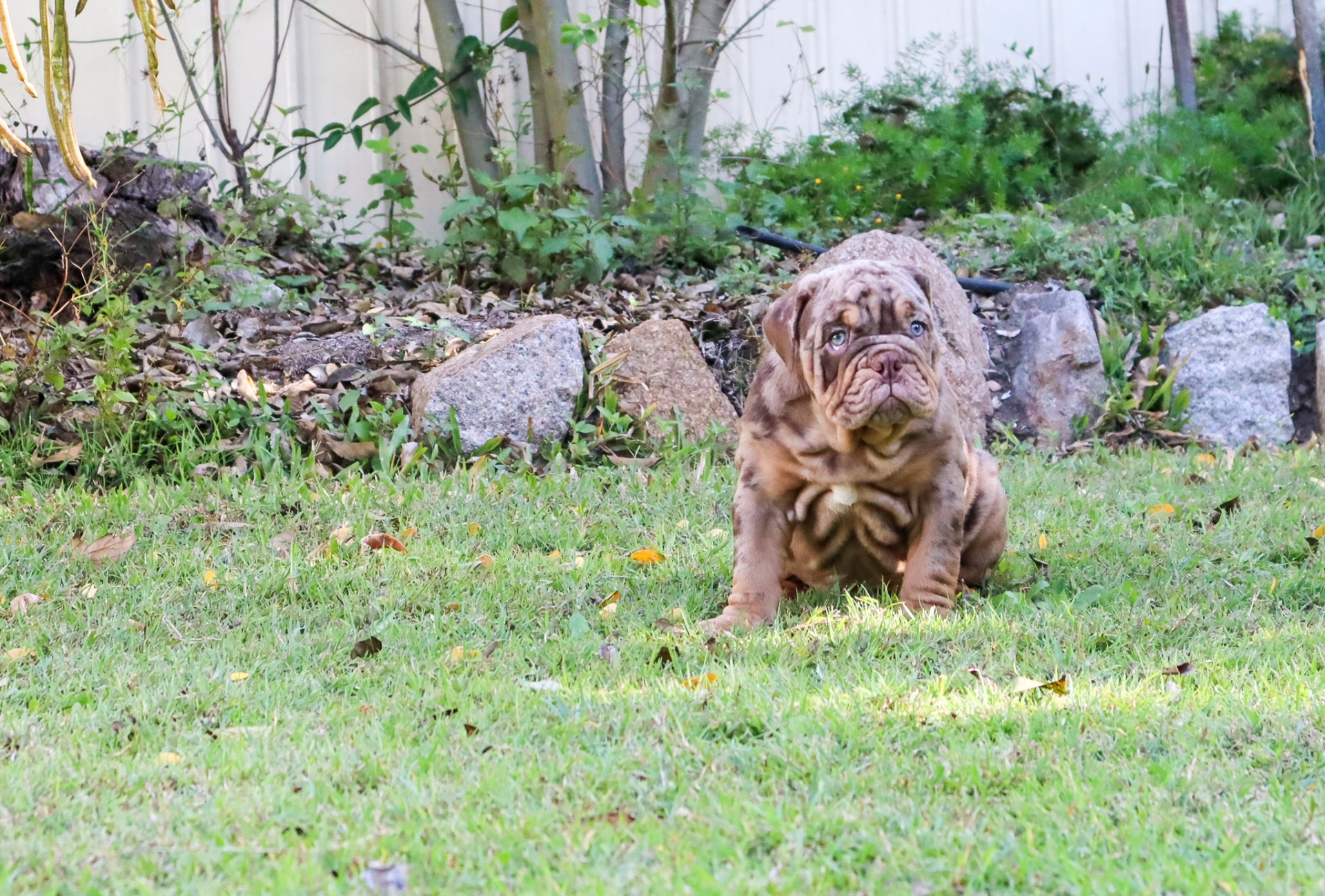
British Bulldogs are calm in a very specific sense. They do not settle reluctantly — they settle completely, without apparent awareness that anything else might be expected of them. In an environment where the dog is physically comfortable and has established its routine, the British Bulldog is among the least reactive of companion breeds to changes in household activity, noise, and external stimulation. This makes them exceptionally well-suited to environments — apartments, urban households, homes with young children — where a more reactive breed would be continuously aroused.
Loyalty in the British Bulldog is expressed as consistent proximity. These are not dogs that are friendly to everyone in equal measure — they are dogs bonded to their household who engage with the world through that lens. With their own people they are attentive and physically demonstrative in the particular bulldoggy way: sitting on feet, following between rooms, positioning themselves in doorways. With strangers they are typically curious rather than wary, but without the indiscriminate enthusiasm of a retriever.
The stubborn independence of the British Bulldog is real and often frustrating to owners who expected trainability similar to a herding or working breed. British Bulldogs assess requests and respond when the assessment is favourable. This is not a flaw to train out — it is the behavioural signature of a breed designed to work independently, and it is inseparable from the qualities that make them calm under pressure. A dog that can be talked into responding immediately is also a dog that can be talked into being unsettled.
For the dog you are considering, or for the program you are building: British Bulldog temperament is not a vague feeling — it is a specific set of behavioural tendencies, developed deliberately over generations, that can be assessed in a breeding animal and carried forward into a litter. Adult temperament is also influenced by environment, ongoing training, physical comfort and individual personality.
“British Bulldog temperament is not a vague feeling — it is a specific set of behavioural tendencies, developed deliberately over generations, that can be assessed in a breeding animal and carried forward into a litter.”
Where Does British Bulldog Temperament Come From?
The British Bulldog was developed in England for bull-baiting — a practice that required courage, persistence, physical tolerance of pressure, and the ability to hold position without losing nerve. When bull-baiting was prohibited in the United Kingdom in 1835, the breed's working purpose disappeared. What followed was a long period of selection toward companion characteristics: the reduction of working drive, the increase of household calmness, and the deepening of tolerance for human environments and human handling.
What was not selected away was the structural persistence that made the breed effective in its working role. The British Bulldog's stubbornness — its capacity to decide on a position and hold it without being easily moved — is that same trait in companion form. It is not aggression and it is not anxiety. It is a dog that experiences the world at low arousal and responds to requests with genuine evaluation rather than reflexive compliance. This is also why British Bulldogs settle into routine with great ease: they assess an environment, determine it is stable, and commit to that assessment deeply.
The loyalty and proximity-seeking that British Bulldogs display is equally a result of this history. A breed selected away from working independence and toward companion function becomes a dog that orients primarily toward its people. The British Bulldog that follows its owner from room to room, that positions itself against a leg or across feet, that monitors the household with quiet attention — this is exactly what two centuries of companion breeding selected for.
For the dog you are considering: understanding where these traits came from makes them less mysterious. The stubbornness that frustrates some British Bulldog owners is the same persistence that made the breed what it was — redirected from working purpose into companion form, and inseparable from the qualities that make the dog what it is. Adult temperament is also influenced by genetics, early socialisation, health and physical comfort, environment, ongoing training and individual personality.
“The stubbornness that frustrates some British Bulldog owners is the same persistence that made the breed what it was — redirected from working purpose into companion form, and inseparable from the qualities that make the dog what it is.”
Is British Bulldog Temperament Inherited or Trained?
Canine behavioural genetics research has established that breed differences in behavioural traits — including reactivity, fearfulness, energy level, and response to novelty — carry a substantial heritable component. This means that what a breeder selects in their breeding animals is reflected in the litter's behavioural baseline, generation after generation. A calm, low-reactive dam contributes to litters that begin life with a lower reactive baseline than an anxious dam tends to produce. Individual variation exists within every litter, and the directional effect of selection on behavioural baseline is well-established across dog behaviour research.
The critical socialisation window in puppies — the period from approximately three to twelve weeks of age, established in foundational veterinary behavioural medicine — is when the developing nervous system is most receptive to learning what the world contains. Puppies exposed to varied environments, sounds, people, handling, and stimulation during this window develop nervous systems that register these things as normal. The breeder primarily manages this window. The puppy leaves the breeder at eight weeks, after the most sensitive period of this window has already closed.
This means the temperament baseline the buyer receives at handover was influenced before they met the dog. Training and ongoing socialisation can shape behaviour significantly — but they are working with a baseline influenced by genetics and early experience. A puppy from a calm, socialised dam, from a breeder who ran structured early exposure, arrives with a different starting point than one who did not receive those things. Adult temperament is also shaped by environment, ongoing training, physical comfort and individual personality.
For the dog you are considering: the question is not just whether the puppy appears calm during the kennel visit — it is what the dam's temperament looks like, and what the breeder ran during the first eight weeks. For breeders: you own the variables that matter most. You can shape temperament through training and socialisation, but you cannot train into a dog what was not selected into its parents.
“You can shape temperament through training and socialisation, but you cannot train into a dog what was not selected into its parents.”
How Does a British Bulldog's Health Affect Its Temperament?
The British Bulldog is a brachycephalic breed, and the degree of airway compromise in any individual dog ranges from minimal to clinically significant. A dog at the minimal end — with appropriate nare width, soft palate conformation, and tracheal diameter — breathes easily at rest. A dog with significant brachycephalic obstructive airway syndrome is working to breathe at baseline. These are not the same behavioural starting point. A dog working to breathe carries a higher resting physiological load — its sympathetic nervous system is more continuously engaged, its patience reserve is lower, and its response to additional stimulation comes proportionally faster.
The research of Marchant et al. (2019) on ADAMTS3 copy number variation in Australian British Bulldogs identified an important airway oedema risk marker considered alongside structure, function, health testing and whole-dog assessment. Selecting against two-copy animals at this gene is one documented genetic decision available to British Bulldog breeding programs in Australia, and it is relevant to temperament precisely because physical comfort is relevant to temperament. A dog that is not managing ongoing physical discomfort has more behavioural reserve available.
Orthopedic considerations — hip and elbow scoring, which are part of the standard documented testing protocol for the breed — are similarly connected to behavioural expression over the dog's life. A dog developing hip or elbow dysplasia is likely to show behavioural changes as pain increases across years. Owners experiencing these changes often attribute them to ageing alone. The documented program that assessed and selected against orthopedic risk before breeding addresses this before it becomes the owner's decade-long reality.
For the dog you are considering: ask for the health documentation of the sire and dam — not because health and temperament are separate things, but because they are not. For breeders: the temperament you help shape is inseparable from the physical condition of the animals you breed. A dog that cannot breathe comfortably at rest is a dog managing physical stress continuously — and that ongoing physical stress influences the behavioural expression the owner experiences day to day.
“A dog that cannot breathe comfortably at rest is a dog managing physical stress continuously — and that ongoing physical stress shapes the behavioural baseline the owner experiences day to day.”
What Does Good British Bulldog Temperament Look Like?
In an adult breeding animal, good British Bulldog temperament looks like this: the dog approaches a stranger at its own pace without coaxing, allows handling — mouth, feet, ears, and body — without resistance or sustained evasion, settles quickly in an unfamiliar environment, does not resource-guard food or toys in the presence of people, and maintains the same behavioural profile in the presence of children, other animals, and mild novelty. These are the markers that matter — not whether the dog is affectionate on cue, but whether its baseline is stable when observed across contexts.
In a litter at the breeder's premises, the markers shift for age. An eight-week-old puppy should be curious without being frantic, approach a new person with interest rather than consistent retreat, recover quickly from a mild startle, and show the early form of the calm engagement that characterises the adult breed. Puppies showing persistent retreat, continuous trembling, hypersensitivity to handling, or inability to settle when placed in a new environment are displaying temperament markers worth noting — not as disqualifiers, but as information about what the baseline is and where it came from.
The dam is the most important temperament reference available at a kennel visit. Her temperament during the critical developmental window influenced every puppy in the litter — through genetics and through the behavioural environment she provided during the first eight weeks. A dam that is anxious, reactive, or uncomfortable with handling has transmitted that behavioural context to her litter. A dam that is calm, curious, and comfortable with handling and with strangers has done the opposite.
For the dog you are considering: spend time with the dam before looking at the litter. Her behavioural profile is the most honest preview available of what the litter's baseline is likely to be. For breeders: the dam's temperament is not assessed separately from her health — it is assessed as part of the same selection decision, and it matters just as much.
“Good temperament in a British Bulldog is not absence of character — it is the expression of a specific character that remains consistent across different environments, different people, and different levels of stimulation.”
What Is a British Bulldog's Temperament Like With Children, Other Dogs, and Strangers?
With children, British Bulldogs are typically patient and tolerant of the physical interaction — patting, leaning, proximity — that young children provide. They are physically solid enough to absorb accidental contact without distress, and calm enough that the unpredictability of children's movement does not register as a reason to escalate. The important variables are the dog's physical comfort level (a dog managing pain has a lower tolerance threshold), the quality of early socialisation with children during the critical developmental window, and the children's own behaviour. British Bulldogs do not require children to be calm, but the quality of interaction is consistently better when all parties are.
With other dogs, British Bulldogs are generally neutral to positive in well-managed introductions. The breed does not carry high working-drive aggression and is not typically an initiator of conflict. Intact males managed in close proximity require the same attention that intact males of any breed require — this is not a breed aggression issue, it is a normal intact male dynamic. Spayed and neutered dogs of either sex integrate into multi-dog households without significant difficulty when introduced appropriately.
With strangers, the British Bulldog is calm and curious without being guard-alert or indiscriminately enthusiastic. They typically approach at their own pace, accept interaction if comfortable, and disengage without escalation if not. This is not timidity — it is the expression of a dog that simply does not register stranger presence as a high-arousal event. In the Australian context, this makes them well-suited to environments with regular visitor traffic, shared housing, and proximity to neighbours.
For the dog you are considering: the key question across all of these relationship contexts is the quality of early socialisation — and that question points directly to the breeder. For breeders: what you expose a litter to in the first twelve weeks is what they carry forward. A British Bulldog socialised well before twelve weeks is a different animal from one that was not — the difference is not in training but in what the dog's nervous system learned about the world during the window when it was most receptive.
“A British Bulldog socialised well before twelve weeks is a different animal from one that was not — the difference is not in training but in what the dog's nervous system learned about the world during the window when it was most receptive.”
How Do I Find a British Bulldog With Good Temperament in Australia?
Finding a British Bulldog with a reliably good temperament means identifying a breeder who treats temperament as a selection criterion — not as a vague commitment to breeding nice dogs, but as a specific, assessable part of the breeding decision applied to every breeding animal in the program. Four things a documented program does for temperament: it selects breeding animals whose temperament can be assessed and is stable; it tests health so physical discomfort is not silently undermining behavioural expression; it owns the critical socialisation window and runs structured early exposure for every litter; and it provides documentation specific to the individual puppy — not a litter summary, but the actual animal going home with the buyer.
Hollywood Bulldogs AUS is registered with MDBA (Master Dog Breeders & Associates). All Hollywood Bulldogs AUS breeding animals are assessed for temperament as part of the selection process — calm, handleable, stable animals are the program's foundation. Every Hollywood Bulldogs AUS breeding dog undergoes documented DNA screening for ADAMTS3 — an important airway oedema risk marker considered alongside structure, function, health testing and whole-dog assessment — and full colour genetics. Cardiac assessments, hip and elbow scores, and physical airway evaluation are current for all breeding animals at the time of every planned litter. Professional veterinary services are engaged on a fee-for-service basis where required. Breeding decisions are made using multiple evidence streams including DNA screening, structure, functional assessment, temperament, health information, pedigree and long-term breeding objectives. No single test determines breeding decisions.
The documentation held by Hollywood Bulldogs AUS records genetic results, health clearances, and full documentation for the sire and dam of every litter. Buyers receive individual documentation for the specific puppy they are placed with — the actual health test results for their dog, not a litter summary. For breeders evaluating Hollywood Bulldogs AUS studs: fresh, chilled, and frozen semen is available from Hollywood Bulldogs AUS sires with full published health and genetic documentation. Contact Hollywood Bulldogs AUS to discuss stud availability and pairing compatibility.
The breeder who selects for calm, assessable temperament in every breeding animal and socialises every litter deliberately is not hoping for good temperament — they are contributing to it.
“The breeder who selects for calm, assessable temperament in every breeding animal and socialises every litter deliberately is not hoping for good temperament — they are contributing to it.”
Key Takeaways
- British Bulldog temperament is specific and observable — calm, loyal, low-reactive, and stubbornly independent.
- Behavioural traits are heritable; the dam's temperament is an important preview of what the litter may be.
- The critical socialisation window (3–12 weeks) is primarily managed by the breeder, not the buyer.
- Physical health influences temperament — a dog managing airway compromise or pain has less behavioural reserve.
- Training shapes the expression of temperament; it does not replace the foundation influenced by genetics and early experience.
- British Bulldogs are typically excellent with children, neutral-to-positive with other dogs, and calm with strangers.
- A documented program selects for stable temperament, tests health, and socialises every litter deliberately.
Ready to apply for a British Bulldog from a program that selects for temperament and tests every breeding animal?
Apply for a puppyFrequently Asked Questions
About Hollywood Bulldogs AUS
Hollywood Bulldogs AUS is an MDBA-registered British Bulldog breeding program focused on evidence-led health selection, ADAMTS3 testing and transparent owner education. Educational content does not replace individual veterinary advice.
MDBA #18715
Continue Exploring the Program
Choosing a Breeder
Are British Bulldogs Good Family Dogs? What Australian Families Need to Know
British Bulldogs are consistently described as calm, loyal, and good with families — and those descriptions are accurate for a dog from a program that built those qualities deliberately. Whether the specific puppy you are considering is that dog depends on the temperament of its parents, what happened in the first twelve weeks of its life, and whether the program that produced it health-tested every breeding animal.

Choosing a Breeder
British Bulldog vs French Bulldog: Which Is Right for Your Australian Family?
British Bulldogs and French Bulldogs are both brachycephalic companion breeds — both calm, both affectionate, both in need of careful heat management in the Australian climate. The choice between them is a lifestyle question about size, temperament, and what daily life with your dog looks like. The choice of program within whichever breed you choose is a health question — and that question matters more than which breed you pick.
Health Testing
British Bulldog Health Testing Australia: Why DNA Is the Only Honest Measure
A British Bulldog can look healthy. That tells you how it looks on that day, in that room. It cannot tell you what it carries. It cannot tell you what it will pass on. DNA testing answers the questions that phenotype cannot.